
Why is my AC running but not cooling?
The system is producing some capacity but not enough. That usually points to restricted airflow, a low refrigerant charge from a leak, a dirty outdoor coil, or a compressor that no longer pumps efficiently.
Local air conditioning help in Lakeland, FL
Cooling problems get diagnosed before parts get replaced. Find out what your system is likely doing, what the repair involves, and what affects the cost — then get an estimate for your home.
Interactive diagnostic
Pick the symptom that matches your system. You will see possible causes and where to read more. This is a starting point for the conversation, not a definitive diagnosis.
Possible causes may include:
Related service
AC Not Cooling Repair →What gets repaired
Diagnosis and repair for residential cooling systems across Lakeland and Polk County.
Read more →What to do when cooling fails during Central Florida heat, and how urgent calls are handled.
Read more →The system runs, but the house never reaches the thermostat setting.
Read more →Air is moving from the vents, but there is no cooling in it at all.
Read more →Nothing happens when the thermostat calls for cooling.
Read more →Ice on the indoor coil or refrigerant line means the system is out of balance.
Read more →Water around the air handler is almost always a condensate problem, not a refrigerant one.
Read more →Control problems can imitate almost any air conditioning failure.
Read more →One of the most common single-part failures in Florida cooling systems.
Read more →The most significant component in the system, and the one that deserves careful evaluation.
Read more →Routine service focused on the failures that actually happen in Florida homes.
Read more →Split systems, packaged units, and heat pumps serving the whole home through ductwork.
Read more →Free tool — no form required
Answer five quick questions to see a broad educational range and the factors that move the number.
Broad potential range
$150 – $900
Factors that may affect cost
On a system this age, repair is usually the more practical direction unless the diagnosis finds a major sealed-system failure.
Estimate ranges are educational only. Actual repair pricing depends on diagnosis, equipment, parts, accessibility, refrigerant type, and system condition.
Understand your cooling system
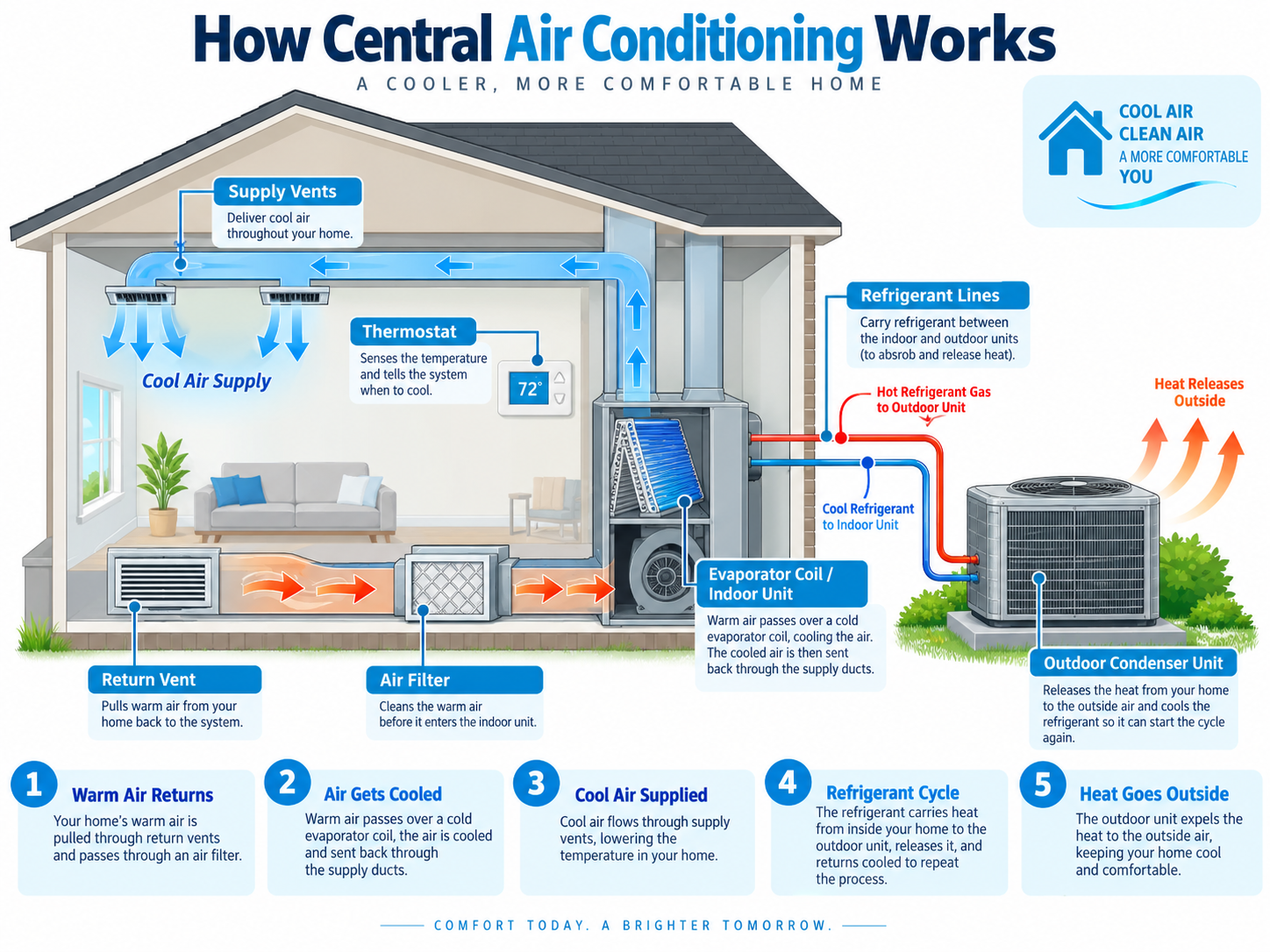
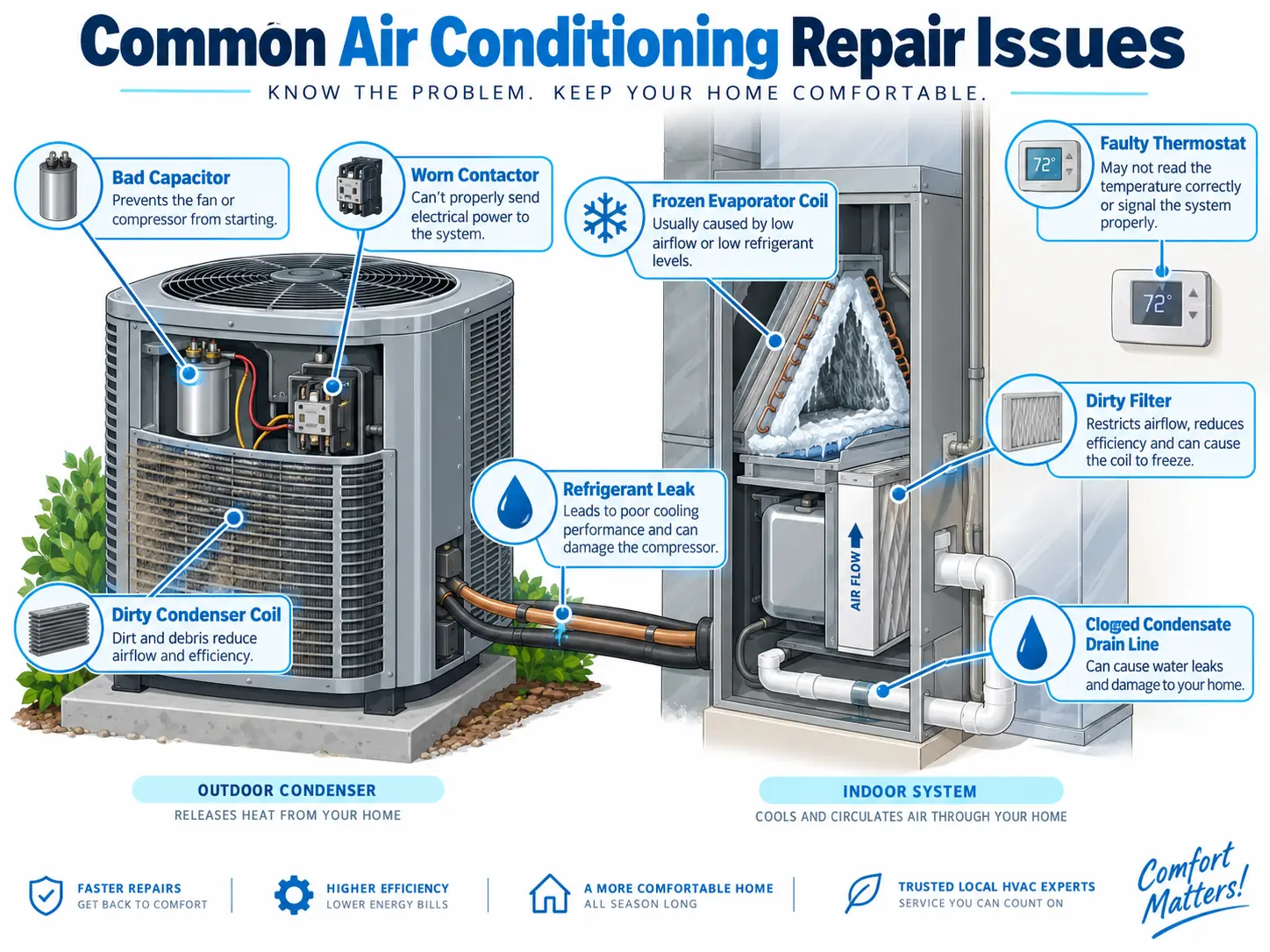
Warm air returns, passes a cold coil, and comes back cooled. Refrigerant carries the heat outdoors, where the condenser releases it. Every repair traces back to one part of that loop.
Built around Lakeland homes
Central Florida runs a long cooling season, so residential equipment here accumulates run hours faster than the same system would elsewhere. That shows up as worn electrical components, tired blower motors, and coils that have had years of dust pulled through them.
Humidity adds a second job. Every hour the system runs it pulls water out of the air, and that water has to leave through a small drain line. Clogged condensate lines are one of the most common reasons a Polk County system shuts itself off, and one of the most damaging when the safety switch is missing.
Airflow ties it together. A filter left in too long, a return that is too small, or duct running through a hot attic all reduce what reaches your rooms — and a starved coil is how systems end up frozen in the middle of summer.
Decision support
This tool gives a direction to explore, not a verdict. A physical diagnosis is what settles it.
Repair may be worth investigating — with a replacement quote for comparison
The mix of age, repair history and severity puts this in the middle. Getting the repair number and a replacement number side by side gives you a real comparison instead of a guess.
| Factor | Repair Considerations | Replacement Considerations |
|---|---|---|
| Equipment age | Systems under roughly ten years old usually have service life left, and parts are typically available. | Past fifteen years, a major repair buys time on equipment that is already near the end of its expected run. |
| Repair frequency | A first failure in several seasons is normal wear and often worth fixing. | Multiple service calls in consecutive seasons suggest broader wear rather than one bad part. |
| Repair cost | Small electrical and drainage repairs cost a fraction of new equipment. | When a single repair approaches a meaningful share of replacement cost, comparing both is reasonable. |
| Refrigerant considerations | Systems using current refrigerants are straightforward to service and recharge. | Older refrigerants are increasingly costly and limited, which affects any repair touching the sealed system. |
| Comfort consistency | If the home cooled evenly before the failure, repair usually restores that. | Persistent hot rooms and high humidity often point to sizing or distribution, which a repair will not change. |
| Efficiency | A well-maintained system operating at spec can be economical to keep. | Newer equipment generally uses less energy, though savings depend on usage, ductwork and installation quality. |
How it works
Call or send the form. What the system is doing, how long it has been happening, and what you already checked.
Testing at the thermostat, air handler and outdoor unit — airflow, electrical values and refrigerant behavior.
What failed, why it likely failed, and what the repair involves. If replacement deserves a look, that gets said too.
Complete the work, then confirm the system is cooling and draining correctly before leaving.
Where we work
Lakeland is home base, with seven supporting communities across Polk County.
Understand your cooling system
Most residential failures cluster around a short list of components. Here is where they live.
Cost guidance
Two homes with the same symptom can land in very different places. Diagnostic time, part cost, refrigerant type, equipment access and whether more than one component failed all move the number.
Why this site is useful
Plain descriptions of what the symptom means and what usually causes it, before anyone talks about parts.
Broad, honest ranges and the factors that move them — not a single number pulled out of thin air.
A short form with the details that actually help: what the system is doing, your ZIP, and how to reach you.
Written around Central Florida homes, long cooling seasons, humidity and condensate drainage.
A comparison you can work through yourself instead of a sales pitch in either direction.
Call or request an estimate from your phone in two taps while standing in front of the unit.
Homeowner checklist
A few safe checks can save a service call, or at least give the technician a head start.
Confirm COOL mode, a setpoint below room temperature, fan on AUTO, and fresh batteries.
Pull the filter and look at it. A gray, matted filter restricts airflow enough to cause real problems.
Check the panel for a tripped AC breaker. Reset it once — if it trips again, leave it off.
Look for water in the drain pan. A float switch shutting the system down is a common cause of no cooling.
Make sure it is running, has clearance, and is not packed with grass clippings or leaves.
Open closed registers and move furniture away from returns so the system can move air.
Note any humming, grinding, clicking or rattling and when it happens. It speeds up diagnosis.
Ice on the copper line or coil means shut the cooling off and let it thaw before anything else.
Safety note: do not open electrical panels, remove the outdoor disconnect, discharge capacitors, or attempt refrigerant work. Those steps carry real shock and injury risk and belong to a trained technician.
The system is producing some capacity but not enough. That usually points to restricted airflow, a low refrigerant charge from a leak, a dirty outdoor coil, or a compressor that no longer pumps efficiently.
Thermostat mode and setpoint, the air filter, the breaker, water in the drain pan, and whether the outdoor unit is running. Those five checks explain a large share of no-cooling calls.
Yes. Highland City, Medulla, Crystal Lake, Kathleen, Combee Settlement, Lakeland Highlands and Mulberry are all covered from the Lakeland location.
It depends on the diagnosis. The cost estimator on this page gives broad educational ranges based on the problem, system age, system type and known component, and the cost guide explains what drives the number.
Age, repair history, severity of the current failure, refrigerant type and efficiency goals all matter. The repair versus replace tool on this page gives a direction to explore, and a physical diagnosis settles it.
Call 863-264-5250 or send a few details and get a repair estimate for your Lakeland home.